Ostia (Ostia Antica, Rome, Italy)

Ancient City
Location
Theatre Type
Earliest Date
18 – 12 BCE
GPS Coordinates
Seating Capacity
Dimensions
Cavea Width: 88 meters
Orchestra Width: 24 meters
Summary
Ostia Roman Theatre (Ostia Antica, Rome, Italy)
Cavea: D 65 m, later enlarged to 88 m, facing north-north-west; ima cavea: 12 rows in 4 cunei; media cavea: 9 rows in 5 cunei; summa cavea: ?9 rows. Capacity: 4,800/6,000 (FS).
Substructures: cavea self-supporting, built on flat land; vaults below cavea; central entrance through cavea to orchestra; enlarged in Late 2nd century BCE by Emperor Commodus (21 arched openings, 2 stories).
Orchestra: D 23.5 m separated from cavea by short wall and 2, wide, steps for prohedrai (honorific seating); orchestra converted into kolymbethra (water-tight pool for aquatic entertainment) in 4th century BCE; space under cavea on either side of central entrance converted into water tanks for filling kolymbethra.
Pulpitum: (stage) L 35.7 m, W 6.5 m; H 1.46 m; proscaenium (front of stage) with 9, decorative niches (5 curved and 4 rectangular); possibly 2 stairways from orchestra level.
Aulaeum: curtain slot (W 1.5 m) in stage.
Scaenae frons: (Scene house front) rectilinear, only fragments remain.
Date: early Augustan (18–12 BCE); 18–17 BCE (Cooley); rebuilt and enlarged (Severus and Caracalla), further restorations by Diocletian and Maximian; and again at end 4th century CE., cavea with arched façade rebuilt 1927. (Source: Sear 129)
The Theatre at Ostia (Modern Ostia Antica, Rome, Italy
(Reprinted with author’s permission)
Author: Jan Theo Bakker, PhD, Leiden, The Netherlands
The theatre was built along the Decumanus Maximus. The outline could already be drawn in the early 19th century. The excavation was completed in the years 1880-1881, 1890, and in the early 20th century. The building was restored very extensively.
Fragments of an inscription tell us that a first theatre was built at the end of the first century BC by Agrippa, the right-hand of Augustus (opus reticulatum and large tufa blocks). It could hold 3000 spectators. It was built together with a large square to the north, the Piazzale delle Corporazioni (II,VII,4).
A large inscription from 196 AD (originally bronze letters inserted in a marble slab) tells us that the theatre was re-dedicated by Septimius Severus and Caracalla. Brick stamps however show that this complete rebuilding had been started by Commodus (176-192 AD). The theatre could now hold 4000 people.
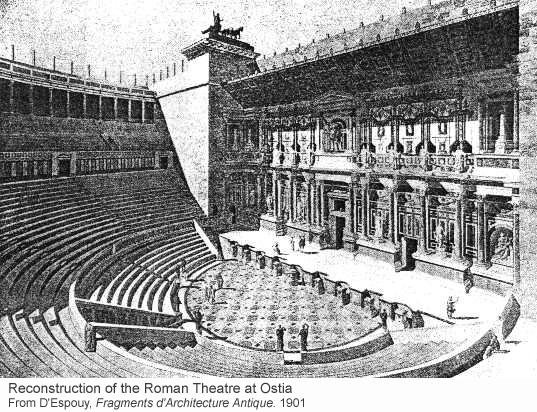
The new theatre was made of brick. The facade is turned towards the street. In front are two nymphaea (II,VII,6-7). This area had a travertine pavement and was surrounded by travertine piers, between which were chains. In the facade are sixteen shops with back rooms. Some shops had simple wall-paintings. They were behind a portico, entered through arches. Between the arches were brick pilasters with travertine bases. There were also arches on the second and third level (on the highest level with windows).
The lower level of the seating area (cavea) could be entered from the Decumanus through a central corridor, and through two lateral entrances. The entrance in the centre of the shops had a pavement and wall revetment of marble. The vault was decorated with stucco reliefs. Four staircases between the shops led to the second and third level. The seating area could be shaded by an awning, suspended from poles inserted in travertine blocks. The seats themselves were probably covered with marble. On the third level were marble columns (now re-erected behind the stage).
The area in front of the seating area (orchestra) had a marble floor. In the front of the stage are five semicircular and four rectangular niches, decorated with marble, including a cornice and small columns. Holes in the stage were used to fasten the scenery. The back wall of the stage has disappeared almost completely. On the stage some marble theatrical masks can now be seen, that once decorated the building.
One ancient text probably refers to the Ostian theatre. In 197 AD Septimius Severus addressed the Senate in Rome and said: “For if it was disgraceful for him [Commodus] with his own hands to slay wild beasts, yet at Ostia only the other day one of your number, an old man who had been consul, was publicly sporting with a prostitute who imitated a leopard” (translation Loeb, E. Cary).
At the end of the fourth century AD the building was restored by a prefect of the grain-supply, Ragonius Vincentius Celsus. A statue of Roma was erected outside the theatre. The orchestra and the stage were connected through steps in two of the rectangular niches in the front of the stage. In the central corridor benches and an arch were built with bases from the Piazzale (the square was no longer being used for commercial purposes). The south part of the central entrance corridor and the two flanking shops with back rooms were blocked and converted to cisterns, with hydraulic mortar (opus signinum). The orchestra could now be flooded for aquatic displays. The water reached the orchestra through two holes in the side walls of the northern part of the corridor. The pool was not very deep: 1.40 meters at most. Naval battles were of course not re-enacted. We should imagine a choreography of the gods and goddesses of the sea and lakes, of nymphs and nereids, presumably scarcely dressed.
At a later point in time the arches of the first level were blocked, so that the building could be used as a fortress. This may have been done in the fifth or sixth century, when Goths and others invaded Ostia and especially Portus.j
Author: Jan Theo Bakker, PhD, Leiden, The Netherlands
(Source: The Internet Group Ostia)
Renovations / Excavations
Ostia Theatre Renovations:
18-17 BCE: fragments of an inscription tell us that the first Ostia theatre was built at the end of the first century BCE by Agrippa, the right-hand of Augustus. The theatre walls were constructed using a concrete core faced with soft limestone (tufa) blocks. The theatre could hold 3000 spectators.
2nd century BCE: the theatre was enlarged. A large inscription from 196 CE (originally bronze letters inserted in a marble slab) tells us that the theatre was re-dedicated by Septimius Severus and Caracalla. The new theatre was faced with bricks that included three tiers of brick arches on the exterior of the cavea. 16 shops occupied the space behind the lower tier of arches. The shop’s Brick stamps however show that this complete rebuilding had been started by Commodus (176-192 CE). The theatre could now hold 4000 people. Source: Baker).
Late 3rd / Early 4th-century: a restoration by Diocletian and Maximian included converting the orchestra into a kolumbethra (a watertight pool that could be flooded for aquatic displays). The two shop spaces between the central cavea entrance were transformed into water reservoirs for filling the kioumbethra. (Source: Sear 129).
5th or 6th century CE: The theatre was reconfigured as a fortress: At a later time the arches of the first level were blocked, allowing the theatre to be used as a fortress. This may have been done when Goths and others invaded Ostia (Baker).
1913 and 1926: the theatre’s interior was excavated and restored under Directors, Poberto Parbeni and Guido Calza.
1938-1945: the theatre’s exterior was restored and the interior was made more presentable as part of Mussolini’s directive to present Ostia at a World’s Fair in Rome (plans were interrupted by WWII).
Ostia Theatre Excavations:
“Rodolfo Lanciani was the first to excavate inside the theatre, during the 1880s, revealing its scaena, orchestra, and cavea. Dante Vaglieri consolidated and extended the scope of this work from 1910, uncovering the theatre’s outer structures. Finally, Guido Calza supervised its reconstruction in the late 1920s. The theatre was built during the Augustan period; it was enlarged by the Severans, and finally, perhaps towards the end of the fourth century, it was modified for aquatic displays.” (Cooley 173)
537 CE: Vitigis and the Goths laid siege to Portus. Ostia abandoned.
600 CE to 1800: Ostia was used as a quarry for construction materials. Statuary and marble ornamentations were extracted for building projects including St. Paul’s in Rome, and marble was burned to produce lime (a necessary component for making concrete).
1802-1805: excavations under the control of Pope Pius VII, and managed by Giuseppe Petrine, “Direttore delle Cave di Ostia.” Ostia’s archaeological plans, including the theatre, were made by Giuseppe Verani and Pietro Holl.
1855-1866: Ostia under the auspices of Pope Pius IX. Excavations by Pietro Ercole Visconti and his nephew Carlo Ludovico Visconti. The workers were some 200 prisoners, who lived in the medieval Borgo.
1877-1898: Rodolfo Lanciani, conducted the first systematic exploration of the ruins including the theatre. Lanciani was active between 1877 and 1889.
1907-1913: Dante Vaglieri continued the work of Lanciani; he conducted systematical excavations of the northeast part of the city.
1914-1924: Roberto Parbeni served as director with Guido Calza, Finelli, and Gismondi as primary excavators. The theatre’s interior was excavated and restored in 1913 and 1926.
1924: Guido Calza becomes director of excavations.
1938-1945: Mussolini initiated excavations: 2/3s of what we see today were completed for a World’s Fair in Rome.The theatre exterior was restored in 1938-1939.
Present Day: Archaeological area now under the jurisdiction of the Soprintendenza per i Beni Archeologici di Ostia. Minor excavation work continues.
(Source “History of the Excavations.” Ostia-Antica.org, 25 May 2024. https://www.ostia-antica.org/dict/topics/excavations/excavations.htm. Accessed 2 July 2024).
Bibliography / Resources:
Bakker, Theo. “Regio II – Insula VII – Teatro (II,VII,2) (Theatre).” Ostia-Antica.org, 1 May 2022. https://www.ostia-antica.org/regio2/7/7-2.htm. Accessed 24 Jul 2024.
Cooley, Alison. “A New Date for Agrippa’s Theatre at Ostia.” Papers of the British School at Rome, Vol. 67 (1999), pp. 173-182.
“History of the Excavations.” Ostia-Antica.org, 25 May 2024. https://www.ostia-antica.org/dict/topics/excavations/excavations.htm. Accessed 2 July 2024.
“Parco Archeologico Di Ostia Antica: Official website.” Ostia-Antica.org. https://www.ostiaantica.beniculturali.it/en/home/ Accessed 34 Jul 2024.
Sear, Frank. Roman Theatres: An Architectural Study. Oxford; New York: Oxford University Press, 2006.
Wikipedia contributors. “Ostia (Rome).” Wikipedia, The Free Encyclopedia. Wikipedia, The Free Encyclopedia, 19 Jul. 2024. https://en.wikipedia.org/wiki/Ostia_(Rome). Accessed 24 Jul. 2024.