Pronunciation Guide This pronunciation guide uses the ordinary symbols of American English with one exception. The symbols Æ and æ are adopted from the International Phonetic Alphabet to represent the sound of “a” as in “pat.” Where two pronunciations are given, they are both acceptable, and usually result from variations between Classical and Church Latin.
aditus AH-dih-tuss
(Latin; pl. aditus: approach or access, entrance to a place). A generic word for any opening to some interior space or cavity. In Roman theatre construction, Vitruvius uses the word to describe audience entrances to the cavea: “The entrances (aditus) should be numerous and spacious; those above ought to be unconnected with those below, in a continued line wherever they are, and without turnings; so that when the people are dismissed from the shows, they may not press on one another, but have separate outlets free from obstruction in all parts.” (Vitruvius, De Architectura).
aditus maximus AH-dih-tuss MÆX-ih-muss
(Latin; pl. aditus maximi: the most important or greatest entrance/access). Roman entrance to the orchestra, typically located between the cavea and the scaena, one on either side of the orchestra; corresponds to the parodos in the Greek theatre.
agora (ἀγορά) æ-gaw-RA
(Greek; pl. agorai: open market or meeting place). Large, open public space which served as a place for citizens of a Greek city to assemble; the word can describe both the assembly of people or the assembly area; the political, civic, religious, and commercial center of a Greek city; buildings for all of these various purposes were constructed as needed in and around the agora. Pausanias describes two types of 5th and 4th-century agorai: ionic (symmetrical layout; rectangular space bounded by colonnades and temples as in Athens, Miletus, and Priene), and archaic (arbitrary layout of colonnades and public buildings as in Elis). The Greek agora influenced the design and layout of the Roman forum.
ambulacrum am-bu-LAH-krum
(Latin; pl. ambulacra: curved corridor or passageway). The cavea (seating area) of a Roman theatre or amphitheatre featured a system of barrel-vaulted corridors that facilitated spectator circulation and access. These curved passageways are the ambulacra. There were typically two types: outer ambulacra that ran around the perimeter of the structure, and inner ambulacra that were integrated within the substructure itself. The term derives from the Latin ambulare meaning “to walk,” reflecting their essential function as circulation spaces that enabled the efficient movement of large crowds during performances and events.
amphitheatre ÆM-fi-thee-ah-ter
(Late Middle English via Latin from Greek amphitheatron). Derives from the ancient Greek ἀμφιθέατρον (amphitheatron), from ἀμφί (amphi), meaning “on both sides” or “around” and θέατρον (théātron), meaning “place for viewing”. An oval or circular, open-air performance space with tiered seating on all sides. A closed Roman arena used for gladiator games, circuses, animal hunts, and executions. “Amphitheatre” does not mean “ancient theatre”: the Colosseum in Rome is an amphitheatre; the theatre at Epidaurus is an ancient theatre.
analemmata æ-na-LEM-a-ta
(Latin; sing. analemma; from Greek ἀναλήμματα: supporting walls). Supporting or retaining walls for the audience seating area in a Roman or Greek theatre; more specifically, the wing walls which flank the stage, and against which the end seats of the auditorium abut.
anapiesma ah-nah-pee-EZ-mah
(Greek; pl. anapiesmata: stage trap door). The stage and orchestra of Greek and Roman theatres featured mechanical devices to enhance dramatic presentations. One such device was the anapiesma, literally meaning “that which presses upward.” This stage trap door allowed characters such as the Furies to rise up dramatically from below the ground level of the theatre, creating spectacular theatrical effects. Later half of the fourth century BCE, according to Pollus; [Ancient source: Pollus, Onomasticon 4.127,132]
architectural orders
(An architectural classification system based on the shape and proportion of classical design elements found in Greek and Roman structures). Orders fall into five styles that are exemplified by their columns: Doric (smooth, simple, round) developed on the Greek mainland, Southern Italy, and Sicily by the 7th century, BCE; Ionic (scrolled-shaped decoration with fluted columns) developed in Ionia (modern Turkey) by the 6th century, BCE; Corinthian (elaborate capital detail with acanthus leaf decoration) was developed late 5th century and used primarily by the Romans; Tuscan (Roman adaptation of Ionic but with smooth columns with simplified capitols); and, Composite (a late Roman development using a highbred of Corinthian and Ionic).
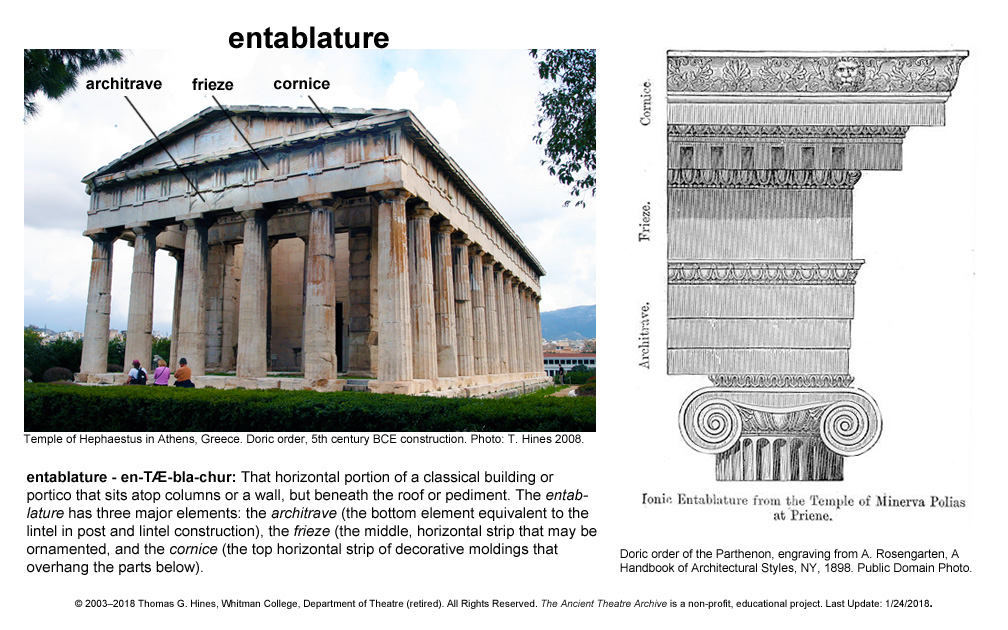
architrave AR-kih-trave
(The bottom element of the entablature in classical architecture). The chief beam. It is the horizontal lintel (beam) that rests upon the column capitals (tops). It is the horizontal entablature element beneath the frieze.
ashlar
(Dressed stonework). rectangular blocks of any type of stone with square corners and dressed surfaces; used in masonry construction.
aulaeum au-LAH-e-um
(Latin; pl. aulaea: drop curtain or stage curtain). The aulaeum was the mechanically operated main curtain of the Roman theatre, positioned immediately behind the proscaenium wall and lowered into a specialized slot at the beginning of a performance to reveal the stage, then raised at the conclusion. Introduced to Rome in 133 BC, the aulaeum operated contrary to modern practice—being lowered to begin a show rather than raised. Archaeological evidence reveals the curtain mechanism consisted of wooden masts attached to the fabric that fitted into stone blocks set at intervals in a slot 3-5 meters deep, running the full width of the stage. Not to be confused with siparia (smaller, portable stage curtains). Also see Greek: katablêma.
aulos (αὐλός) OW-loss
(Greek: musical instrument). An ancient, double-reeded musical instrument similar to an oboe; typical musical instrument used to accompany theatrical performances; sometimes translated as “flute.”
baldachin or baldaquin BALL-da-kin
(From Italian: baldaccino, canopy of state). An architectural canopy of stone, metal, or fabric. In an ancient theatre such as Miletus, it is a stone or marble structure built in the form of a canopy that signifies status and serves as a roof to shelter an area from the weather, example of baldachin remains are the columns as found in the center of the ima cavea at the theatre at Miletus, Turkey.
balteus BAL te us
(Latin; pl. baltei: low stone wall or parapet separating the orchestra from the surrounding seating area). In Roman theatres, the balteus is a thin stone or marble wall, typically 0.90-1.00 metres high, that runs around the rim of the orchestra and separates it from a narrow passageway behind it. Beyond this passageway lie the broad steps where the seats of honour (bisellia) for senators and magistrates were placed. While modern writers sometimes use balteus to refer to the entire passageway system, strictly speaking the term refers only to the stone wall itself, with the correct term for the wall being podium (as evidenced by inscriptions). The balteus wall served both as a physical barrier and as a marker of social hierarchy, defining the privileged seating area around the orchestra rim that was reserved for the Roman elite.
basilicas ba-SIL-ih-kas
(Latin; pl. basilicas: large foyer structures flanking a Roman stage). In Roman theatre architecture, the basilicas are the large foyers positioned on each side of the stage building, containing openings (versurae) for access to the stage. The basilicas often had roofs and could extend beyond the edges of the cavea. While the term versurae is commonly used to denote these spaces, strictly speaking, versurae refers to the re-entrants at the corners of the stage or the projecting wings, making it an unjustifiable extension to apply the word to the rooms beyond.
Bisellia Steps bih-SELL-ee-a steps
(Latin: platforms or steps for honorific seating): One or more curved, wide walkways (praecinctiones) surrounding a Roman theatre orchestra; used as platforms for seats of honor (prohedrai). May be multi-tiered.
bisellium bih-SELL-lee-um
(Latin; pl. bisellia: ceremonial double-wide seat of honor in Roman theatres). In Roman theatres, the bisellia were special thrones placed on the broad steps (podium) that ran around the rim of the orchestra, positioned between the orchestra floor and the lowest row of regular seating. These seats were twice the width of ordinary seats and served as places of honor for magistrates, whose right to occupy them was considered a mark of high social status. Those who held this privilege were known as biselliarii or bisellarii, and they styled themselves as such in inscriptions. The bisellia were typically constructed of fine materials, such as pink breccia and white marble, often featuring decorative elements like griffins’ feet as supports. Also see: prohedria and pulvinar.
Bouleuterion (βουλευτήριον) boo-loo-TEE-ree-on
(Greek; pl. bouleutêria). Building for members of the council chamber; an assembly hall for magistrates; town hall. A meeting hall where the boule (city council) would convene in ancient Greek city-states.
bronteion bron-TEH-i-on
(Greek; pl. bronteia: thunder-making device). Roman theatres inherited various acoustic and mechanical devices from Greek theatrical tradition to enhance dramatic performances. One such device was the bronteion, a apparatus used to create the sound of thunder during plays. The bronteion typically consisted of bronze vessels, metal sheets, or stones that could be shaken, struck, or rolled to produce thunderous sound effects. This sound device was positioned backstage or in the upper levels of the scaenae frons (stage building) where operators could create realistic thunder sounds to accompany storm scenes or divine appearances in theatrical productions. The term derives from the Greek bronte meaning “thunder,” reflecting its specific acoustic function in ancient theatrical performance.
cancellus can-CEL-lus
(Latin; pl. cancelli: barrier or grill structure in the orchestra area). While the word normally means a barrier or grill in general Latin usage, in the theatrical context cancellus may refer to a protective barrier around the orchestra, similar to the balteus wall but with a grilled or openwork design. An inscription from Ammaedara dating to the time of Diocletian specifically mentions cancelli around the orchestra, suggesting these barriers were used to separate the privileged seating area from the performance space. The term appears in a graffito from Thugga mentioning “monitores cancelli” (monitors of the barriers), indicating that theatre staff were responsible for supervising these protective structures. The cancellus represents one of several Latin terms used to describe the various barrier systems that controlled access and provided protection around the orchestra in Roman theatres. Also see: balteus or parapet
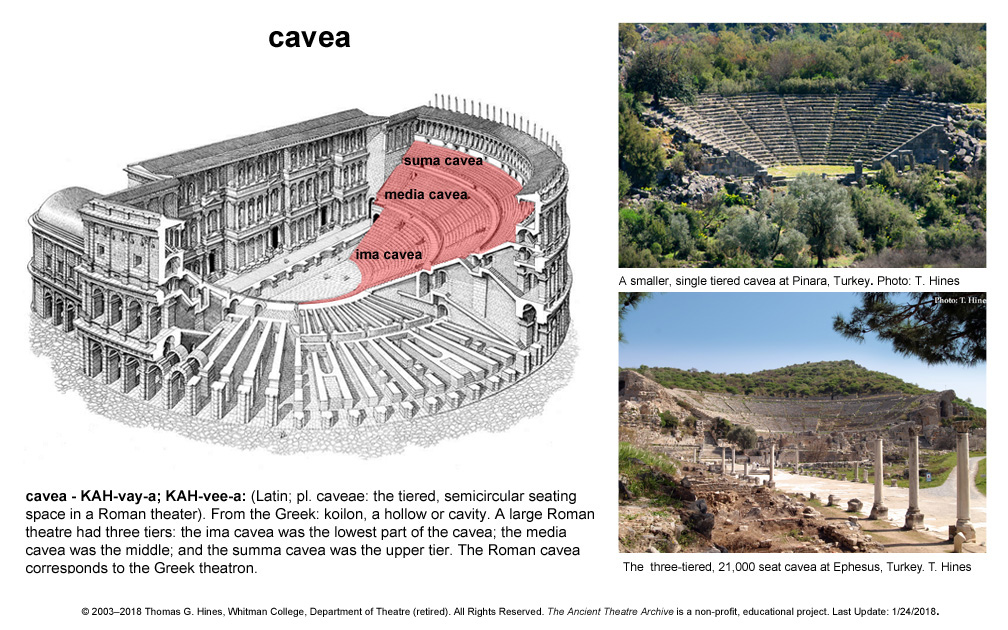
cavea KAH-vay-a; KAH-vee-a
(Latin; pl. caveae: the tiered, semicircular seating space in a Roman theater). From the Greek: koilon, a hollow or cavity. A large theatre had three seating tiers (maeniana): the ima cavea (also referred to as maenianum primum) was the lowest part of the cavea; the media cavea (also referred to as maenianum secundum) was the middle, and the summa cavea (also referred to as maenianum summum) was the upper tier. Social rank dictated the seating restrictions for the audience with the ima cavea reserved for the upper echelons of society (senators and equestrians), the media cavea was reserved seating for pleb togata (respectable citizens); and those with lesser status (mixed crowd of urban poor, foreigners, slaves, and women) were restricted to the upper or summa tier. The Roman cavea corresponds to the Greek theatron.
Charonioi klimakes KAH-vay-a; KAH-vee-a
(Greek: stairway to or from the underworld). Underground passage leading from offstage to an opening in the center of the orchestra (also known as Charonian or Charon stairway); Charon was the mythological ferryman who conveyed the souls of the dead across the Styx; used by the chthonic deities or for “ghostly apparitions” (Pollux); examples at Argos, Siracusae, and Eretria; not a typical feature of Greek theatre construction.
chorêgos (χορηγός) kaw-ray-GAWSS
(Greek; pl. chorêgoi) Wealthy citizens who funded performances in Greek theatre.
chorodidaskalos (Χοροδιδάσκαλος) kaw-roh-dih-DAES-ka-lawss
(Greek: pl. chorodidaskaloi). Chorus teacher/director; taught songs/dances to chorus; originally performed as well.
clepsydra klep-SIH-dra
(Latin; pl. clepsydrae: from the Greek, klepsydra, “water thief”). Ancient water clock; an ancient device for measuring time by the gradual flow of water. Remains found at Priene theatre in Turkey suggest that the theatre was used for timed debates and speeches.
Colonnade co-lo-NAYD
(Latin: a row of pillars or columns). From the Latin root of columna, or pillar. A row of columns, often free-standing, separated from each other by an equal distance. The row may be curved or straight and may support a covered roof or enclose an open space.
columnatio co-lum-NAH-ti-o
(Latin; pl. columnationes: architectural element composed of free-standing columns). The scaenae frons (stage house front) of a Roman theatre ranges in height from one to three stories and is typically pierced by three doors and ornamented with one to three tiers of columns, balconies, and statues. The decorative column feature is the columnatio. The word describes the tiered column component as a whole rather than as individual groupings of columns.
Corinthian order kaw-RIN-thee-un
(Most elaborate of the Greek architectural styles and least used by the Greeks). Resembles Ionic in most aspects except for the column capital; Corinthian columns have tall capitals shaped like upside-down bells and are covered with rows of acanthus leaves and small vine-like spirals called helixes. The Corinthian order was originally used for columns inside buildings and did not appear externally until the 4th century BC; use in exterior temple colonnades did not become widespread until Roman times.
cornice COR-niss
(Topmost element of the entablature in Classical architecture). The horizontal band that crowns the top of an architectural feature such as a colonnade, wall, or doorway. It typically projects out and over the frieze. It is composed of three parts: the bed, corona, and cymatium.
Coryphaeus kaw-rih-FIE-us; kaw-rih-FAY-us
Latin; pl. coryphaeus: the leader of the chorus in ancient Greek drama). Greek: koryphaios.
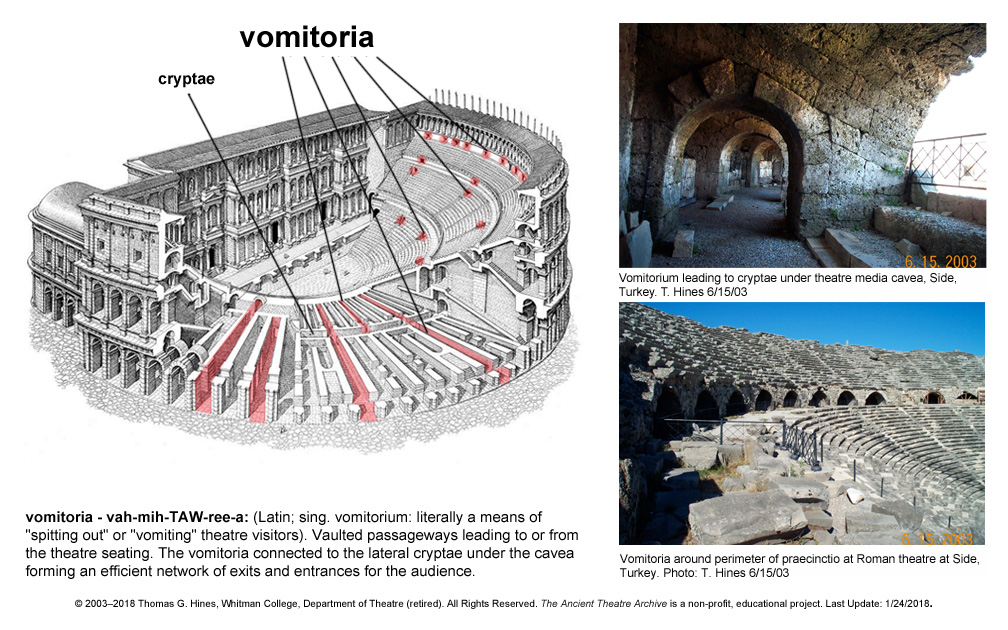
cryptae KRIP-tie; KRIP-tay
(Latin; sing. crypta: vault, grotto, covered gallery/passage/arcade). Large curved barrel-vaulted corridor beneath the audience seating (cavea) for audience traffic. Large theatres may have more than one. These corridors ran from one side of the cavea to the other and were intercepted by a network of smaller corridors (vometoria) that allowed access to the cavea seating.
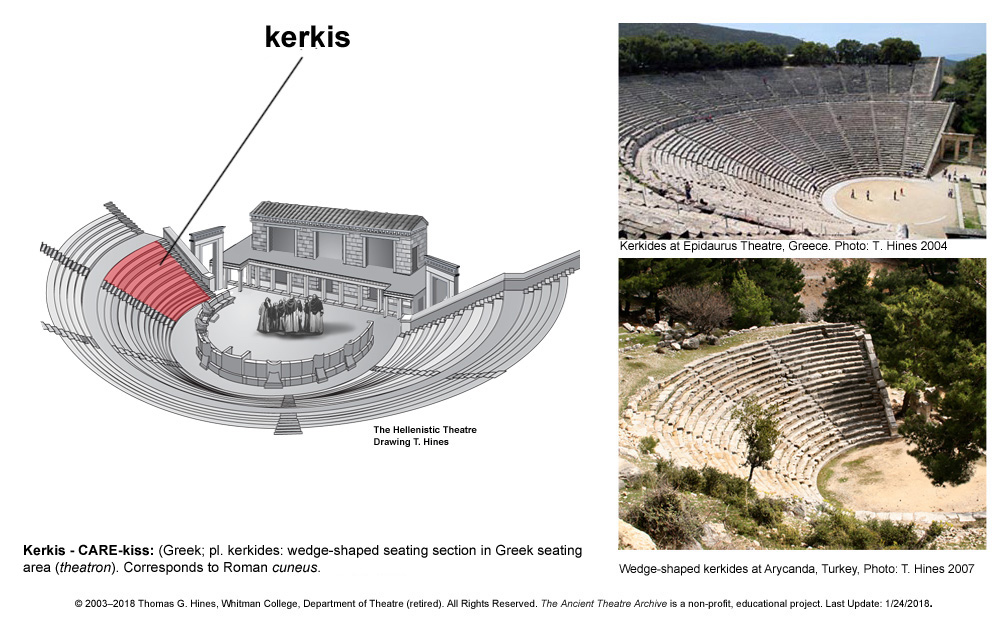
cuneus koo-NAY-us ; koo-NEE-us
(Latin; pl. cunei: a wedge-shaped object). The wedge-shaped seating section in the Roman theatre; corresponds to Greek kerkis
deus ex machina DEH-oos ex MA-kee-na
(Literally “God from machine.” Late 17th cent.: modern Latin, translation of Greek theos ek mēkhanēs, ‘god from the machinery’). A Greek theatre convention where a deity is flown to the stage from above or raised from below using a machine, (mēchanē), to solve a problem. A contrived solution to remedy an apparently insoluble plot issue. Convention from 5th century BCE playwrights Aeschylus, Sophocles, and Euripides and described by Aristotle (Poetics) and Pollus (Onomasticon). Various Greek and Roman crane machines are described by Vitruvius (De Architctura), but none are specific to the theatre. A team of engineers from the University of Patra is investigating stone slots in the earth behind the scene house at the Theatre of Phlius, Corinthia. They speculate these may have been sockets for a crane base. No other extant evidence to support the design.
diazoma (διάζωμα) die-AH-zoh-ma
(Greek; pl. diazomata: girdle). A horizontal, curved walkway separating upper theatron seating, (epitheatron), from the lower theatron seating, (theatron proper); corresponds to Roman (praecinctio).
didaskaliai (διδασκαλίαι) dih-dah-skah-LEE-eye
(Greek: derived from the verb διδάσκειν, the singular didaskalía has the general meaning of ‘teaching’, or ‘instruction’). The Greek plural noun didaskaliai (instructions) came to refer to records of dramatic performances, containing names of authors and dates, in the form of the original inscriptions or as later published by Alexandrian scholars.
Dionysia (Διονυσία) die-a-NEE-see-æ
Greek religious festival held in honor of the god Dionysos celebrating the grape harvest and wine. Two festivals: 1. the Greater or City Dionysia celebrated in March/April, and 2. the Lessor or Rural Dionysia celebrated in December/January. The performance of theatre was at the heart of the festival; the Theatre of Dionysos in Athens served as the first and most important of the festival theatres.
Dionysos (Διονύσου) die-a-NEE-suss; die-a-NEE-sawss
(Greek; Latin: Dionysus). Also known as Dionysos Eleutherios (the liberator); Greek god; Son of Zeus and Semele, a mortal woman of Thebes; god of the grape harvest, wine, agriculture, ritual madness, religious ecstasy, and fertility; patron god of Greek theatre. Often portrayed in the company of the Maenads, Satyrs and Sileni. Festivals were held in honor Dionysos: the Lessor or Rural Dionysia, the Greater or City Dionysia, the Anthesteria, and the Lenaea. The Roman counterpart to Dionysos is the god Bacchus.
dithyramb (διθύραμβος) DIH-thih-ram
(Greek: dithyrambos). An ancient hymn or poem sung and danced honoring Dionysos; competitive dancing chorus, performed by 50 men or boys; one of the competitive elements in the Festival of Dionysos; the origin of drama according to Aristotle; can refer to the poem as well as the performance.
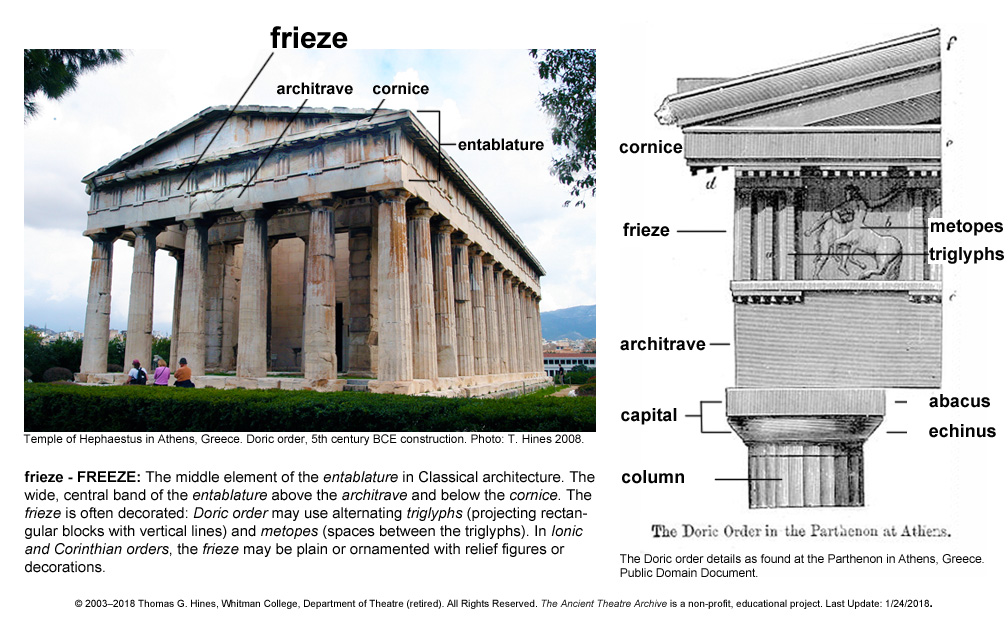
Doric order DAW-rik
Architectural style presumably developed on the Greek mainland and in southern Italy and Sicily. Although the Doric order is traditionally credited with slightly pre-dating the Ionic order, both orders were established by the end of the seventh century. Doric columns are slightly tapered, simple, and sturdy and have no base. Shallow, parallel groves (flutes) run from the bottom to the top of the shaft. The Doric capital consists of two parts, a round echinus and a square abacus. Above the capital is the architrave consisting of an unadorned beam supporting a frieze of alternating triglyphs (vertical, weight supporting blocks with three vertical grooves) and metopes (non-load bearing panels either decorated with relief sculpture or left plain). A simple cornice molding at the top of the architrave extends to protect the parts below from rain.
echea e-CHE-a
(Greek; pl. echea: literally “echoers” in Greek; bronze or terracotta vessels used to enhance sound in the theatre). According to Vitruvius, echea were bronze or terracotta vessels placed in specially constructed niches (cellae) positioned halfway up the auditorium to amplify the voices of actors on stage. Archaeological evidence for these acoustic devices has been found at various sites, including Corinth (where bronze echea were taken to Rome by Mummius in 146 BC), Lyttus in Crete, Gioiosa Ionica, and Hippo Regius. The vessels varied in material and size, with examples ranging from small terracotta tubes to large dolia (jars) measuring up to 1.20 meters in diameter. While their actual effectiveness remains debated by modern scholars, the echea represent the ancient world’s sophisticated understanding of theatrical acoustics and their commitment to ensuring optimal sound projection throughout the auditorium.
eisodoi (εἴσοδοι) AYS-oh-doy
(Greek; sing. eisodos: passageways leading to the orchestra between the koilon and the skēnē). Eisodoi was the name used by Aristophanes for the parodoi. The two names are often interchanged. In some plays, the left (eastern) eisodos lead to the country whereas the right (western) passageway was the route to the city.
ekkyklēma (ἐκκύκλημα) ek-KICK-lay-ma
(Greek: “roll-out machine”). Moving platform used in Greek performances for revealing or changing scenes. A wheeled platform or cart, housed within the skēnē and used to bring interior scenes into view; reveal the result of an “out of view” action, e.g. the murder of Agamemnon in Aeschylus’s Agamemnon. According to Bieber, the ekkyklēma was introduced in 5th century BCE Greece; could be square, semi-circular, or round; may have revolved on a pivot, and may have been used in conjunction with moving screens (scaena ductilis).
entablature en-TÆ-bla-chur
That horizontal, architectural portion of a classical building or portico that sits atop columns or a wall, but beneath the roof or pediment. The entablature has three major elements: the architrave (the bottom element equivalent to the lintel in post and lintel construction), the frieze (the middle, horizontal strip that may be ornamented, and the cornice (the top horizontal strip of decorative moldings that overhang the parts below).
episkenion (επισκήνιον) ep-ih-SKAY-nee-on
(Greek; pl. episkenia: literally the upper upper story of the Greek Hellenistic skēnē ). In the early, Hellenistic theater the episkenion was the second floor of the skēnē or Greek stage house. It was recessed from the roof of the proskenion. The proskenion roof was the stage (logeion) in the Hellenistic theater. The episkenion facade was pierced by one or more openings, (thyromata) that could be fitted with painted panels or doors.
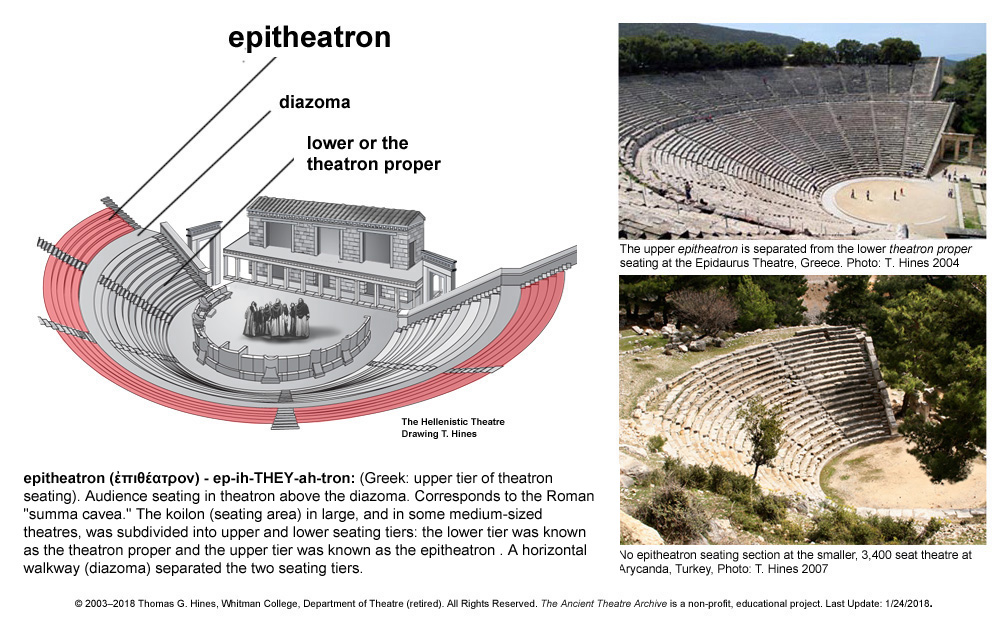
epitheatron (ἐπιθέατρον) ep-ih-THEY-ah-tron
(Greek: upper tier of theatron seating). Audience seating in theatron above the diazoma. Corresponds to the Roman “summa cavea.” The koilon (seating area) in large, and in some medium-sized theatres, was subdivided into upper and lower seating tiers: the lower tier was known as the theatron proper and the upper tier was known as the epitheatron . A horizontal walkway (diazoma) separated the two seating tiers.
euripus (εὔριπος) YOU-rih-puss
(Greek; pl. euripoi: narrow water drainage channel, a canal, conduit or aqueduct). This was the water drainage trench that ran around the perimeter of the orchestra in ancient theatres. In more sophisticated constructions the euripos was covered with paving tiles and connected to an underground sewer system.
forica FO ree ka
(Latin; pl. foricae: a public privy): Multi-seat Roman toilet found in public areas. A private, single-seat toilet was known as a latrina, pl. latrinae, (hence our word latrine). Early Roman foricae were little more than a wooden plank over a trench. Stone foricae were constructed over a sewer system and flushed with running water. The Romans cleaned themselves with a sea sponge on a stick (tersorium or xylospongium). The shared tersorium was rinsed in a bucket of water with vinegar or salt. More discerning visitors brought their own sponge. Although forica and latrina refer to different types of Roman toilets, the word, latrinae, and its modern equivalent, latrine, have evolved to refer to any large, public bathroom.
frieze FREEZE
The middle element of the entablature in Classical architecture. The wide, central band of the entablature above the architrave and below the cornice. The frieze is often decorated: Doric order may use alternating triglyphs (projecting rectangular blocks with vertical lines) and metopes (spaces between the triglyphs). In Ionic and Corinthian orders, the frieze may be plain or ornamented with relief figures or decorations.
gradus GRAH-duss
(Latin; pl. gradus: Roman cavea seat; step or position). According to Vitruvius the gradus, “…are not to be less than twenty inches in height, nor more than twenty-two. Their width must not be more than two feet and a half, nor less than two feet.” Seats could be carved from the theatre site’s living rock or assembled from carefully dressed and fitted (ashlar) masonry. Ashlar bench seats were often hollowed beneath the front edge for increased leg room. Prohedria (seats of honor) are less common but can be found in both Greek and Roman theatres
Hellenistic
Term describing the period of Greek civilization from 323 BC (death of Alexander the Great) to 31 BC (Roman victory at the Battle of Actium and the resulting decline of Ptolemaic power in Egypt); term derived from Hellene, the word Greeks used to describe themselves; term coined by the German historian Johann Gustav Droysen to differentiate between a Greek culture dominated by ethnic, city-state Greeks and a Greek culture dominated by Greek-speakers of various ethnicities governed by larger monarchies.
histrio HIS-trih-oh
(Latin; pl. histriones: stage actor or performer). Roman theatre featured professional actors who performed in comedies, tragedies, and other dramatic works for public entertainment. These performers were the histriones. Originally derived from Etruscan theatrical traditions, histriones were typically of low social status, often slaves or freedmen, despite their artistic skills and public popularity. They performed wearing masks and costumes appropriate to their characters, and the most successful histriones could achieve considerable fame and wealth. The term eventually broadened to encompass any type of stage performer or entertainer, and gives us the English word “histrionic,” reflecting the theatrical and dramatic nature of their craft.
hypokritēs (ὑποκριτής) hip-oh-krih-TAYSS
(Greek; pl. hypokritai: actor).
hyposcaenium hy-po-SKAY-ni-um
(Latin; from Greek hyposkenion: area beneath the stage). The hyposcaenium was the substructure or basement area located directly underneath the stage platform (pulpitum) of a Roman theatre. According to Sear, “the area under the stage was called the hyposkenion in Greek, but the word, hyposcaenium, which is frequently used of Roman theatres, has no classical authority.” This space served multiple practical functions including housing the machinery for the aulaeum (drop curtain), whose slot was separated from the rest of the hyposcaenium by a parallel wall running 1.50-2.50 metres behind the proscaenium wall. The hyposcaenium also contained acoustic enhancement features, such as the large terracotta vessels (dolia) found at theatres like Nora in Sardinia, which may have been placed there for sound amplification. In some theatres, passageways were inserted into the hyposcaenium to allow animals access to the arena when buildings were converted for gladiatorial spectacles, as occurred at Tauromenium. Additionally, the space housed inclined platforms for stage machinery and sometimes contained tunnels running from under the proscaenium to the middle of the orchestra, facilitating special effects and dramatic entrances from below the stage level.
hyposkēnion (ὑποσκήνιον) hy-po-SKAY-nee-on
(Greek; Latinized as hyposcaenium: space beneath the stage). The hyposkēnion was the area under the raised stage (proskenion) in Greek theatre, serving both structural and functional purposes. In Hellenistic theatres, where stages were typically elevated 2.5-4 meters above the orchestra level, the hyposkēnion formed the supporting foundation and front wall of the proskenion. The front of the logeion (stage) was supported by the hyposkēnion (front wall of the proskenion). This space beneath the stage often contained doorways that allowed passage from the hyposkēnion into the orchestra, particularly in theatres like Selge. As theatres evolved for multiple uses, the hyposkēnion became increasingly important for practical staging needs. Sear notes that the area under the stage was called hyposkenion in Greek, but emphasizes that “the word, hyposcaenium, which is frequently used of Roman theatres, has no classical authority.” The Roman adaptation separated the curtain slot from the rest of the hyposcaenium space, demonstrating how this under-stage area served different functions in Greek versus Roman theatrical architecture. In later periods, when theatres were converted for gladiatorial games, passageways were often inserted into the hyposkēnion to allow animals to enter the arena.
ikria (ἴκρια) IH-kree-a
(Greek; the word is plural, no singular: the planks of a deck, or more generally, a platform or stage). The temporary scaffold seating in early Greek theatre consisting of tiered, wooden bleachers resting on wooden supports. The ancient writers Photius, Eustathius, Hesychius, and the Suda cite the collapse of temporary ikria at the Athens Agora during the 70th Olympiad (500-496 BCE) as motivation for the construction of the permanent Theatre of Dionysos at the foot of the Athens Acropolis. (Dinsmoor 120).
ima cavea EE-ma KAH-vay-a
(Latin: lowest tier of cavea seating). Most desirable seating in Roman theatres; reserved for the upper echelons of society (senators and equestrians).
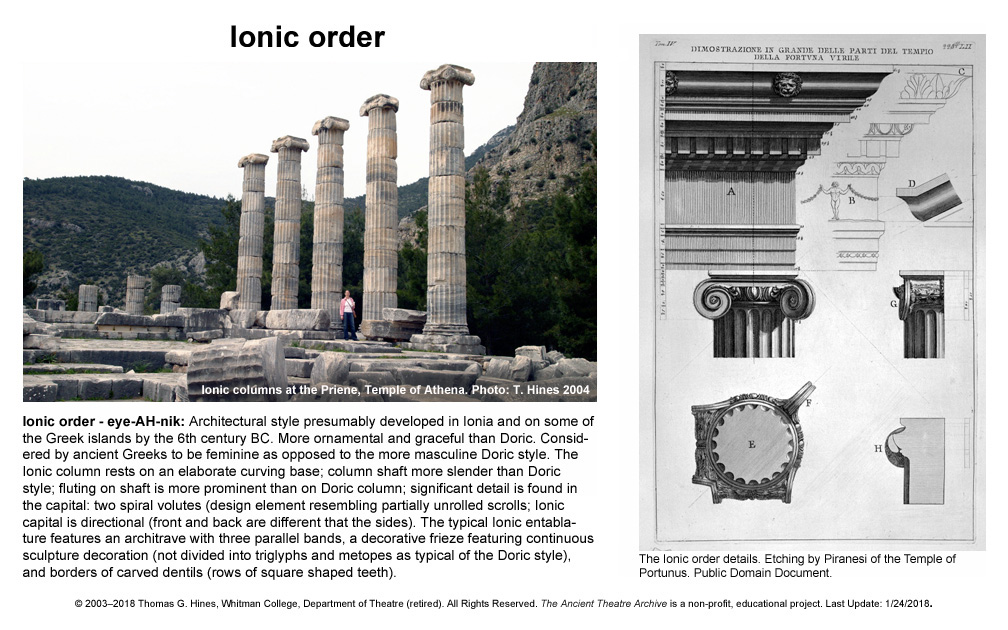
Ionic order eye-AH-nik
Architectural style presumably developed in Ionia and on some of the Greek islands by the 6th century BC. More ornamental and graceful than Doric. Considered by ancient Greeks to be feminine as opposed to the more masculine Doric style. The Ionic column rests on an elaborate curving base; column shaft more slender than Doric style (height to base ratio of early Ionic columns: 8 to 1, Doric ratio: 4 to 1 and 6 to 1); fluting on shaft is more prominent than on Doric column; significant detail is found in the capital: two spiral volutes (design element resembling partially unrolled scrolls; Ionic capital is directional, (front and back are different than the sides). The typical Ionic entablature features an architrave with three parallel.
itinera versurarum ih-TIH na-ra ver-suh-RAH-rum
(Latin: side doors used by actors to enter the stage). The doors in the Roman basilica (tower like structures flanking the Roman Stage). Also see: versurae.
katablêma (κατάβλημα) kah-TAH-blay-mah
(Greek; alternative spelling: katablemma: drop curtain or stage covering). The katablêma was the Greek equivalent of the Roman aulaeum, functioning as a drop curtain in ancient Greek theatre according to Pollux. Pollux. The katablêma served to conceal and reveal the stage area as needed during performances, though its use appears to have been less standardized than the later Roman aulaeum system. The term literally means “that which is thrown down” or “covering,” reflecting its function as a theatrical covering device. While the Roman theatre developed sophisticated mechanical systems for curtain operation, the Greek katablêma represented an earlier, simpler approach to stage concealment that varied considerably between different theatres and periods. See: aulaium in Roman theatre.
keraunoskopeion (κεραυνοσκοπεῖον) kehr-ow-no-sko-PAY-on
(Greek; lighting machine according to Pollux). Lightning effect using mirrored surfaces to reflect sunlight.
kerkis (κερκίς) CARE-kiss
(Greek; pl. kerkides: wedge-shaped seating section in Greek theatron (seating area). Corresponds to Roman cuneus.
klepsydra (κλεψύδρα) klep-SIH-dra
(Greek; pl. klepsydrai: Greek water clock). The remains of such a clock at the theatre at Priene, Turkey, is evidence that public debate occurred at the theatre. Used for timing speakers. Alternate Latin spelling: clepsydra.
klimakes (κλίμακες) klep-SIH-dra
(Greek; sing. klimax: stairs). Audience stairways in Greek seating area (theatron). The staircases (klimakes) that separated the wedge-shaped seating sections (kerkides) of the Greek theatron. In a multi-tiered theatron, the staircases lead to curved walkways (diazomata) that separated the seating galleries. Corresponds to the Roman: scalae.
koilon (κοίλος) KOI-lon
(Greek; pl. koila: a hollow or cavity). The bowl-shaped seating area of the ancient Greek theatre. The word is occasionally used as the equivalent to the Greek theatron or the Latin cavea.
kolumbēthra (κολυμβήθρα) kaw-lum-BAY-thra
(Greek; pl. kolumbēthrai: pool or swimming bath). An orchestra adapted for water spectacles in Roman theatres. Numerous theatres such as those at Ostia and Siracusae in Italy, Hieropolis and Ephesus in Turkey, and Dionysus in Athens show evidence of late third to early fifth-century Roman alterations including water cisterns, waterproofed orchestra walls, improved drainage, and water pipes. Corresponds to the Latin word, “lacuna.”
koryphaios (κορυφαῖος) kaw-rih-FIE-us
(Greek: speaker or leader of the Greek chorus). One function of the leader was to carry on a dialogue with the actors. Latin: coryphaeus.
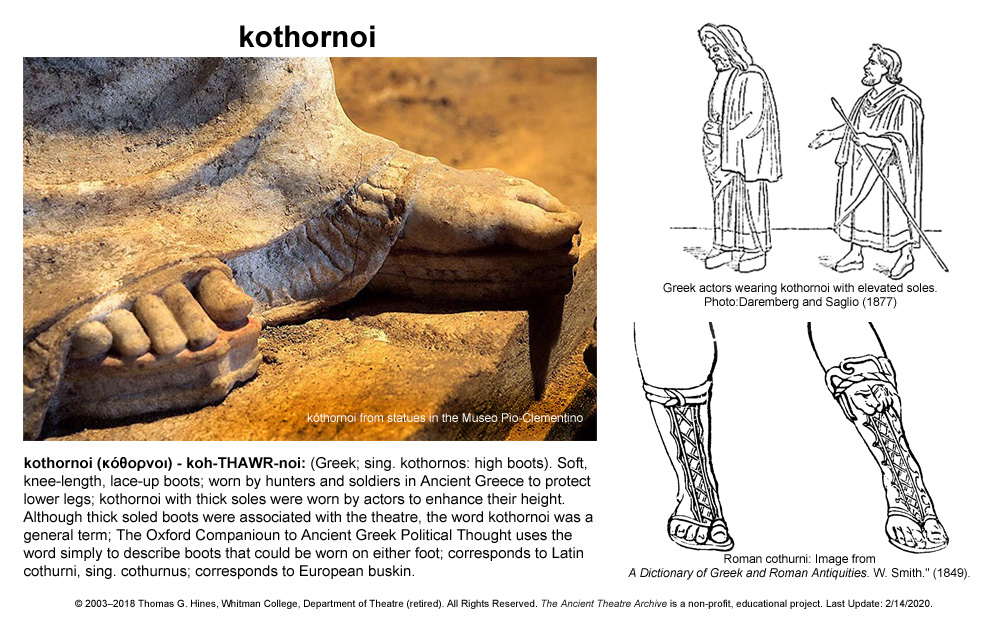
kothornoi (κόθορνοι) koh-THAWR-noi
(Greek; sing. kothornos: high boots) Soft, knee-length, lace-up boots; worn by hunters and soldiers in Ancient Greece to protect lower legs; kothornoi with thick soles were worn by actors to enhance their height. Although thick soled boots were associated with the theatre, the word kothornoi was a general term; The Oxford Companioun to Ancient Greek Political Thought uses the word simply to describe boots that could be worn on either foot; corresponds to Latin cothurni, sing. cothurnus; corresponds to European buskin.
latrina lah TREE na
(Latin; pl. latrinae: washing place, privy, private Roman toilet). Contracted from lavatrina (“place to bathe”), from lavo (“wash, bathe”). Latrina were located in private homes or some other private space and not accessible to the public at large. The word that best denotes a public toilet is forica. Foricae were larger, multi-holed, and found in public areas such as theatres. Although forica and latrina refer to different types of Roman toilets, the word, “latrinae,” and its modern equivalent, “latrine,” have evolved to refer to any large, public bathroom.
logeion loh-GAY-on
(Greek; pl. logeia: a speaking place, a stage). A high stage used by actors in Hellenistic theatres. Located behind the orchestra and before the skênê. The front of the logeion (stage) was supported by the hyposkênion (front wall of the proskenion). The remains of a logeion can be found at Priene, Turkey. The remains of access ramps from the parodoi to the logeion can be found at Sicyon, Greece. Logeion corresponds to the shorter Roman stage (pulpitum).
lyra (λύρα) LEE-rah
(Greek: stringed instrument similar to a small harp with a sounding board made from a tortoise shell). Ancient Greece, recitations of lyric poetry and dramatic performances were accompanied by lyre playing; played by being strummed with a plectrum (pick) rather than being plucked like a harp; earlies image from1400 BCE on the sarcophagus of Hagia Triada, Minoan settlement in Crete).
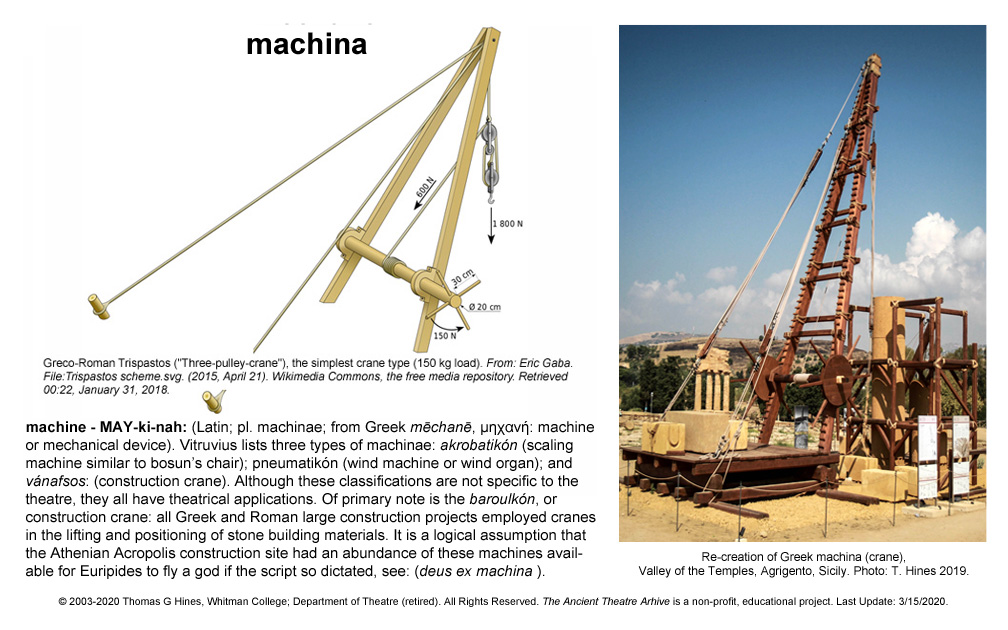
machina MAH-ki-nah
(Latin; pl. machinae; from Greek mēchanē, μηχανή: machine or mechanical device). Vitruvius lists three types of machinae: akrobatikón (scaling machine similar to bosun’s chair); pneumatikón (wind machine or wind organ); and baroulkón: (construction crane). Although these classifications are not specific to the theatre, they all have theatrical applications. Of primary note is the baroulkón, or construction crane: all Greek and Roman large construction projects employed cranes in the lifting and positioning of stone building materials. It is a logical assumption that the Athenian Acropolis construction site had an abundance of these machines available for Euripides to fly a god if the script so dictated, see: (deus ex machina ).
maeniānum mine-YAH-num
(Latin; pl. maeniāna: a balcony; a horizontal block of seating in a Roman theatre). Originally, a projecting balcony overlooking the Roman forum for viewing gladiatorial displays. In the theatre, one of the tiers or blocks of seating, banding the cavea. Seats within a maeniānum were separated by stairways into wedges of seating called cunei, whereas, the maeniāna were separated vertically by walkways or praecinctiones. The maenianum primum was the lowest tier of seating; the maenianum summum) was the middle tier. The maenianum summum was the upper tier. (also see ima cavea, media cavea, and summa cavea).
media cavea: MEH-dee-a KAH-vay-a
(Latin: middle section of auditorium seating). Roman middle tier of cavea seating. The media cavea was reserved seating for plebs togatae (respectable citizens).
naumachia now-MAH-kih-ah
(Latin: literally “navel combat,” staged sea-battles performed on water for mass entertainment purposes). Staged “group combat” that could involve thousands of combatants and full-sized ships of war ; due to scale of the spectacle, naumachiae were usually staged in lakes but smaller scaled-down, battles could fit into a Roman amphitheatre; earliest was staged by Julius Caesar in 46 BCE. The term, “naumachia,” could refer to the spectacle or to the basin or building where it was staged.
odeion or odeon OH-dee-on
(Greek) A small, roofed theater or recital hall used for entertainment such as performed music, poetry readings, debates, or lectures. See: Roman odeum.
odeum OH-dee-um
(Roman; from the Greek word odeion, literally, “singing place;” corresponds to the Greek word odeion or odeon). A small, roofed theater or recital hall used for entertainment such as performed music, poetry readings, debates, or lectures. The prototype odeion was the Odeion of Pericles (Odeon of Athens), a mainly wooden building by the southern slope of the Acropolis of Athens. Plutarch described it as ‘many-seated and many-columned’ and may have been square, though excavations have also suggested a different shape, 208 x 62 feet.
okribas (ὀκρίβας) aw-KRIH-bahss
(Greek: temporary stage or platform). A raised wooden platform; a speaking or announcement place; a temporary logeion.
orchēstra AWR-kess-tra
(Latin; borrowed from Greek orchestra (ὀρχήστρα), the dancing place). The orchēstra was the primary performance space for the chorus in Greek theatre; also adapted for use as an arena for Roman “spectacle entertainment.” The orchēstra was the space between the audience and the Greek skēnē or Roman scaena possibly rectilinear in Early Classical Greek theatre; circular in Classical Greek theatre; horseshoe-shaped in Hellenistic theatre; semicircular in Roman theatres.
parabasis: (παράβασις) pa RAH ba sis
(Greek; pl. parabaseis: an important choral ode in Greek Old Comedy). The parabasis was delivered by the chorus at an intermission in the action while facing and moving toward the audience. It was used to express the author’s views on political or religious topics of the day.
Paraskēnion: (παρασκήνιον) pa-ra-SKAY-nee-on
(Greek; pl. paraskenia: two side buildings on either side of the Greek stage). Projecting side additions to the skēnē; one to two story side wings on either side of the Hellenistic proskênion; may have provided additional stage entrances; usually ornamented with columns or pillars supporting a frieze. Corresponds to the Roman basilica.
parodos (πάροδος) PÆ-roh-dos
(Greek; pl. parodoi: literally “side road”). Side entrance into the orchestra of a Greek theater (one on each side) between the audience seating (koilon) and the scene building (skēnē); primary entrance/exit for the chorus. Also used by audience for entrance and exit from theatre; also an ode sung by the chorus as it first enters the orchestra. May also be used to describe the arched entrance through which the chorus entered. Alternate name: eisodoi.
periaktoi: (περίακτοι) peh-RIH-ak-toy
(Greek; sing. periaktos: from Greek, revolving; three-sided, revolving scenic device for quickly changing the scene). This was a device for changing scenery by mounting three upright, painted flats on a triangular base. By rotating the unit, three different painted “looks” could be revealed to the audience. Used for quickly changing scenic backgrounds.
phallos (φαλλός) fah-LOSS
(Greek; comedic costume accessory representing a penis)
pinakes: (πίνακες) PIH-na-kess
(Greek; painted scenic panels used in performances). Scenic elements (painted flats) placed in the openings (thyromata) of the Greek skēnē in Hellenistic theatres. Painted to represent locations during performances and could be easily changed as required.
podium POH-dee-um
(Latin; raised platform, shelf, or stage). See: Greek logeion or Latin pulpitum.
porta PAWR-ta
(Latin; pl. portae). A Roman gate or doorway.
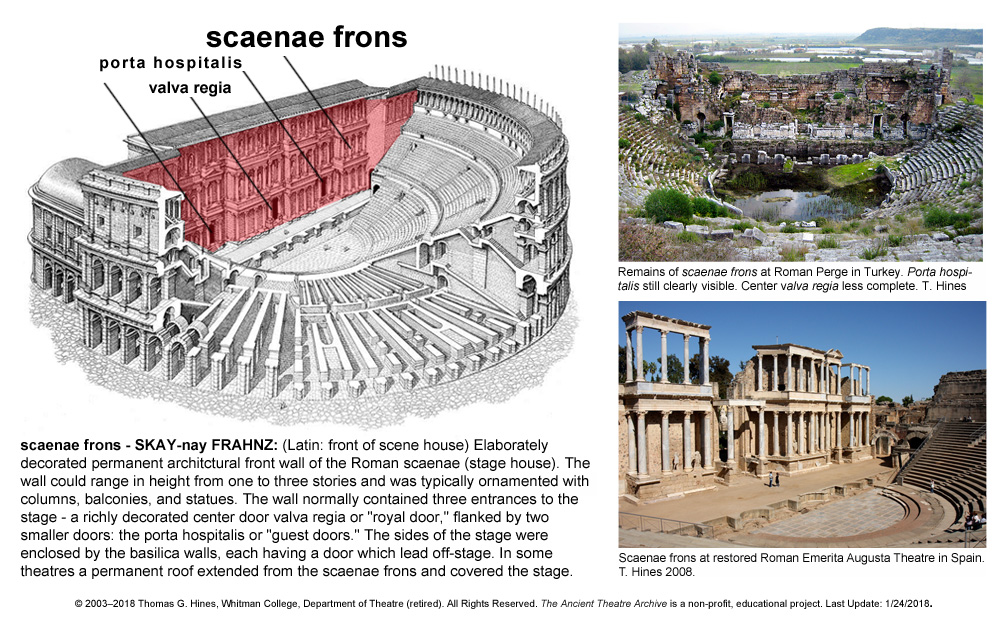
portae hospitales POR-tie haw-spih-TAH-less
(Latin; sing. porta hospitalis: guest doors). Two doors on either side of the central door in the Roman scaenae frons. Door on right reserved for second actor – left door for person of less importance. The word “portae” refers to domestic doors. The center door, valva regia, was the principle door reserved for royalty or the main actor. Vitruvius: “The parts of the scene are to be so distributed, that the middle door may be decorated as one of a royal palace; those on the right and left, as the doors of the guests or strangers.” Vitruvius, de Architetura, Book V.
porticus POR-tih-cuss
(Latin; pl. porticus: porch). Long covered ambulatory with a roof carried on colonnades, sometimes attached to a building, and sometimes a separate structure. An open structure with a roof supported by columns. In a Roman theatre the covered colonnade at the rear of cavea or behind scene house. “Behind the scenes porticus are to be built; to which, in the case of sudden showers, the people may retreat from the theatre.” (Vitruvius).
portus post scaenas POR-tuss post SKY-nahss, (Church Latin: SKAY-nahss)
(Latin: passageway behind the scene house). A portico or passageway behind the scaenae (scene house) of a Roman theatre.
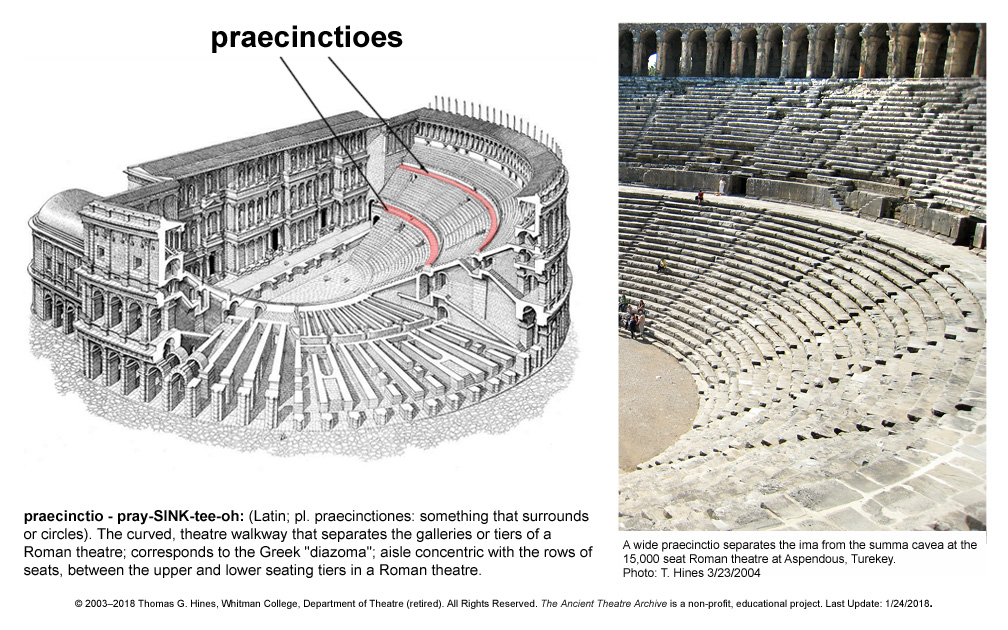
praecinctio pry KINK tee oh
(Latin; pl. praecinctiones: something that surrounds or circles). The curved, theatre walkway that separates the galleries or tiers of a Roman theatre; corresponds to the Greek “diazoma“; aisle concentric with the rows of seats, between the upper and lower seating tiers in a Roman theatre; a synonym of balteus.
prohedra (προέδρα) pro HED ra
(Greek; pl. prohedrai: literally chair in front; an ornate seat of honor in the Greek theatre for dignitaries, officials, and priests). The number of seats varied from a single seat for the statue of Dionysos to an entire row of seats. The center seat in the front row was reserved for the priest of the god Dionysos-Eleuthereus at the Dionysian Festival in Athens. Beside him sat the other priests and officials. Seats were made from carved stone and usually had backs. Note: prohedria (προεδρία – pro hed RI a) is the privilege of sitting in these honorific seats. “Pollux calls the first row of seats the prohedria, [Onomasticon, 4. 121–2], although strictly the word refers to the privilege of sitting in the front seats of a theatre, not to a physical location. (Sear 5).
proskēnion (προσκήνιον) proh-SKAY-nee-on
(Greek: proskēnion literally means “something set up before the skēnē). In Hellenistic theatres such as Priene, the proskēnion included the theatre’s high stage (logeion), the skēnē’s side stages (paraskēnia), and the logeion’s decorated, supporting wall (hyposkēnion). All were in front of the skēnē “scene house” or, pro-skēnion.
pulpitum: PULL-pih-tum
(Latin; pl. pulpiti: a pulpit, platform, or actor’s stage). Roman theatre stage (logeion in the Greek theatre). A platform for a public speaker in front of the scaenae frons; Vitruvius gives the maximum height as five feet as opposed to the ten to twelve-foot height of the Hellenistic logeion. Also can refer to the protective wall (cancellous) that separates the first row of cavea seating from an orchestra that has been converted into an arena, or as a barrier for retaining water in an orchestra converted for naumachia (water spectacles). See also Latin, podium.
pulvinar pul-VEE-nar
In Roman theatres, particularly those in the eastern provinces, the pulvinar was a special elevated seating area positioned on the central axis of the cavea and reserved for high-ranking officials such as provincial governors. Unlike the side-mounted tribunalia, the centrally-located pulvinar provided optimal viewing while ensuring its occupants remained visible to the audience, reflecting their elevated social status within the theatre’s carefully structured social hierarchy.
sacrarium sa-KRAH-ri-um
(Latin; pl. sacraria: sacred space or shrine). Roman theatres often incorporated religious elements into their architectural design, as theatrical performances had sacred origins and were typically held during religious festivals. A small shrine or sacred space within or adjacent to the theatre complex is the sacrarium. These sacred areas housed statues of deities, particularly those associated with drama such as Dionysus/Bacchus, or honored the patron gods of the city. The sacrarium served both as a place for pre-performance rituals and offerings, and as a permanent reminder of the divine connection between theatrical art and religious worship in Roman society.
scaena ductilis SKY-nah, (Church Lat. SKAY-nah) DOOK-ti-liss
(Latin: moving or guided scene). A pair of painted, movable screens that could be opened and pushed to either side of the stage. The remains of foundation tracts at the theatre of Megalopolis in Greece suggest the use of a huge version of this scenic device.
scaenae SKAY-nay, SKY-nigh
(Latin; sing. scaena: theatre scene or stage house). From the Ancient Greek, skēnē. In the Roman theatre usually referring to the stage house or building behind the pulpitum (stage); corresponds to the Hellenistic skēnē. Often used in the pl. (scaenae) because it was composed of multiple parts.
scaenae frons SKAY-nay FRAHNZ
(Latin: front of scene house). Elaborately decorated permanent architectural front wall of the Roman scaenae (stage house). The wall could range in height from one to three stories and was typically ornamented with one to three tiers of columns (columnatio), balconies, and statues. The wall normally contained three entrances to the stage – a richly decorated center door, valva regia or “royal door,” flanked by two smaller doors: the porta hospitalis or “guest doors.” The sides of the stage were enclosed by the basilica walls, each having a door which lead off-stage. In some theatres a permanent roof extended from the scaenae frons and covered the stage.
scalae: SKA-ligh
(Latin; used in the plural: stairs). Audience stairways in Roman seating area (cavea). The staircases (scalae) that separated the wedge-shaped seating sections (cunei) of the Roman cavea. In multi-tiered seating, the staircases lead to curved walkways (praecinctions) that separated the seating galleries. Corresponds to the Greek, klimakes. Vitruvius references scalaria when talking about staircase systems in the theatre. (Vitruvius, De Architectura, Book V)
siparium sih-PAH-rih-um
siparia si-PAH-ri-a (Latin; sing. siparium: movable stage drapes). Siparia were portable fabric hangings that could be positioned anywhere on the Roman stage to provide concealment for performers, particularly mimes, allowing them to hide until their cue to appear. Unlike the mechanically operated aulaeum (main drop curtain), siparia were flexible staging elements that could be set up as needed throughout the performance space. These drapes served both practical and decorative functions, offering actors strategic concealment while contributing to the visual presentation of theatrical productions. Ancient sources indicate that siparia were sometimes painted with human figures and could also be stretched on the scaenae frons as backdrop decoration, though their primary theatrical function remained as movable concealment devices for performers awaiting their entrances.
skênographia (σκηνογραφία) skay-no-graf-EE-ah
(Greek: the painting of the scene). Scenic decoration according to Aristotle, (Poetics 1449a).
skeuê skeh-OO-ay
(Greek; pl. skeua: stage properties and theatrical equipment). The performances in ancient Greek theatre required various movable objects, costumes, and mechanical devices to support the dramatic action. These theatrical apparatuses are the skeuê. The term encompasses a wide range of items, including props, masks, costumes, mechanical devices like the ekkyklema (wheeled platform) and mechane (crane), as well as painted scenery panels (pinakes).
skēnē (σκηνή) skay NAY
(Greek: “tent,” the building behind the orchestra in a Greek theatre). Originally used for storage but provided a convenient backing for performances; also used as a waiting area/dressing room for actors; its evolution included doorways (center, left, and right) and a covered, high stage for performances. Corresponds to the Roman scaenae.
socle SOH-kull
(From Latin socculus: a light shoe). Also, a stone support for columns.
summa cavea SOO-ma KAH-vay-a
(Latin: highest tier of cavea seating in a Roman theatre) Used by less distinguished or common audience members such as urban poor, foreigners, slaves, and women).
tetimimi TAY-tee-mee-mee
(Italian: “Thetis-mimes [Water nymph performers];” a particular type of entertainment featuring nude or semi-nude men and women swimming and dancing in the water). Introduced to Rome as early as the 1st century but became popular in the 3rd and 4th centuries CE. These performances occurred in flooded Roman theatre orchestras (kolumbēthrai) and amphitheaters. Named after “Thetis,” a mythological sea nymph, goddess of water or Nereid, and “mimi” Italian for mimes or performers. The word, “Tetimimi”, is a modern, Italian word coined by Gustavo Traversari in Gli Spettacoli In Acqua Nel Teatro Tardo-Antico. Rome. 1960.
tetrastoon (τετράστοον) te TRA stoh on
(Greek). Four rows of columns; also, a meeting place or public square.
theaomai (θεάομαι) thay-AH- oh-my
(Greek: to gaze at or behold). To view as spectators in the theatre.
theatai (θεαταί) theh-ah-TIE
(Greek; sing. theatēs). Spectators.
theatron (θέατρον) THEH-ah-tron
(Greek; pl. theatra: “the seeing place” of the Greek theatre). The audience sat in the theatron to watch a performance of a Greek play: alternate name, koilon, a hollow or cavity. The theatron originally referred to the audience space of the Greek theatre, but later became synonymous with the entire structure consisting of the spaces for both the audience as well as the performance; Roman spelling: theatrum. Also see: Roman cavea.
theatrum thay-AH-trum
(Latin). Corresponds to the Greek theatron.
theatrum peculiare thee-AH-trum peh-ku-li-AH-reh
(Latin; pl. theatra peculiaria: private or special-purpose theatre). Roman society included various types of theatrical venues beyond the standard public theatres, with some built for specific functions or exclusive audiences. These specialized performance spaces are theatra peculiaria. The term encompasses privately owned theatres constructed by wealthy individuals for their personal use, temporary theatrical structures erected for specific events or festivals, and purpose-built venues designed for particular types of performances such as religious ceremonies or elite entertainment.
theatrum tectum thee-AH-trum TEHK-tum
(Latin; pl. theatra tecta: covered theatre building). Roman theatre architecture included both open-air venues and enclosed performance spaces designed for year-round use and protection from weather. The indoor theatre building is the theatrum tectum. These structures featured roofed auditoriums with reduced seating capacity compared to their outdoor counterparts, typically accommodating more intimate performances such as musical recitals, poetry readings, and smaller dramatic works.
theologeion the-o-lo-GAY-on
(Greek; pl. theologeia: elevated speaking platform for divine characters). The skene (stage building) of a Greek theatre sometimes featured a raised platform or upper level where gods and divine beings could appear and speak to mortals below. This elevated space is the theologeion. Literally meaning “place where a god speaks,” the theologeion allowed for the dramatic convention of divine intervention and the appearance of deities, often resolving plot conflicts through deus ex machina. The platform was typically located above the main stage level, emphasizing the separation between the divine and mortal realms and providing a visually dramatic entrance point for supernatural characters in Greek tragic and comic performances.
theorikon (θεωρικόν) theh-oh-rih-KAWN
(Greek). Festival fund that subsidized entrance fees at the Athenian Dionysia; recipients restricted to Athenian citizens; establishment of subsidy may date to Pericles ca. 450 BC; theoric fund established to either grant tickets free of charge or to provide monetary distributions for use at the festival; fund often cited as evidence supporting an Athenian concern for universal accessibility to theatre but arguments can be made that the fund also allowed the state to control and stabilize ticket prices.
thimelici: thih-MEH-lih-kee
(Latin; Greek: thymelikoi). Lyric and dancing performers primarily restricted to the orchestra in the Hellenistic theatre.
thymelē (θυμέλη) thih-MEH-lay
(Greek; an altar in the middle of the orchestra, and/or a podium for the conductor of the choir). The leader of the chorus possibly used the thymelē as a platform during dialogues between the chorus leader (koryphaios) and the chorus; altars could be cylindrical or rectangular.
thyromata (θυρώματα) thih-ROH-ma-ta
(Greek; sing. thyroma). Openings or doorways and their frames that pierced the facade of the skēnē or episkenion in the Hellenistic theatre.
thyrsos (θύρσος) THEER-sos
(Greek: the branch or wand carried by followers of Dionysos). A wand or staff of giant fennel (Ferula communis) covered with ivy vines and leaves, sometimes wound with taeniae and topped with a pine cone, artichoke. The thyrsus is typically associated with the Greek god Dionysos, and represents a symbol of prosperity, fertility, and hedonism. “A wand wreathed in ivy and vine leaves, with a pine cone at the top, carried by worshippers of Dionysus.” (Howatson and Chilvers, Concise Oxford Companion, 543.)
tribunalia trih-byoo-NAH-lee-a
(Latin; sing. tribunal: elevated boxes or galleries for magistrates). The tribunalia were the prestigious boxes occupied by praetors and other magistrates who presided at theatrical games, positioned above the lateral corridors (aditus maximi) at the sides of the cavea, typically only a few metres above stage level. These boxes were strategically located to ensure their occupants remained in full view of the audience, emphasizing their social status and authority. Sometimes used as a generic term for any significant seat of honor, such as a Pulvinar.
valva regia VAL-va RAY-gee-a
(Latin; pl. valvae: royal doorway). The central door in the Roman scaenae frons wall; door used by the principal actor. The doors on either side of the central door were the portae hospitales (guest doors). The plural “valvae” was a word associated with temple doors or other grand doors while the word “porta” referred to a domestic door. “The parts of the scene are to be so distributed, that the middle door may be decorated as one of a royal palace; those on the right and left, as the doors of the guests or strangers.” (Vitruvius, De Architectua, Book V).
velarium veh LAH ree um
(Latin; pl. velaria: an awning in a Roman theatre or amphitheatre that stretched above the audience as protection from the sun and elements). Also referred to as velum.
velum VAY-lum
(Latin; pl. vela: sail, covering). A fabric covering or awning used to shade the audience in the Roman theatre. Also referred to as velarium.
venationes vay-hah-tih-OH-ness
(Latin; sing. venatio: “animal hunts”). A type of entertainment in ancient Rome that involved the hunting and killing of wild animals. Public spectacle that featured contests between beasts or between men and beasts, usually in connection with gladiator shows.
versurae vehr-SOO-rye
(Latin; sing. versurus: side entrance onto the Roman stage). Entrances on either side of a Roman stage. Commonly used to denote the large foyers (basilicas) that flank the stage, but strictly speaking, versurae refer to the entrances themselves. Vitruvius speaks of the versurae procurrentes as providing the two lateral entrances to the stage. Greek and Roman stage directions indicate that the right entrance was to or from the forum or city and the left entrance was to or from the country or foreign locations. (Vitruvius).
via venatorium VEE-a veh-na-TAW-ree-um
(Latin; road or way of the hunter). A complex of hallways and rooms which housed animals and equipment; found in Roman theatres designed to accommodate gladiator combat or animal hunts.
vomitoria vah-mih-TAW-ree-a
(Latin; sing. vomitorium: entrance/exit passageways. Literally a means of “spitting out” or expelling theatre attendees). The vaulted passageways leading to or from the theatre seating. The vomitoria connected to the lateral cryptae under the cavea forming an efficient network of exits and entrances for the audience.
Compiled by Thomas Hines, Professor Emeritus, Whitman College. Editors and phonetic advisors:
Clara Hardy, Professor of Classics, Carleton College, and Edward E. Foster, Professor Emeritus, Whitman College.
Bibliography:
Although the glossary words and definitions were compiled by the author from numerous sources, I wish to acknowledge the following significant works:
Art & Architecture Thesaurus: The Getty Research Institute. Getty Research Institute, www.getty.edu/research/tools/vocabularies/aat/index.html.
Bieber, Margarete. The History of the Greek and Roman Theatre. 2nd ed., Princeton University Press, 1961.
Brockett, Oscar G., and Franklin J. Hildy. History of the Theatre. 10th ed., Allyn and Bacon, 1999.
Dictionary of Greek and Roman Antiquities. Edited by William Smith, et al., 1890, www.perseus.tufts.edu/cgi-bin/ptext?doc=Perseus%3Atext%3A1999.04.0006.
Dinsmoor, William B. The Architecture of Ancient Greece. 3rd ed., rev., W. W. Norton, 1975.
Izenour, George. Roofed Theaters of Classical Antiquity. Yale University Press, 1992.
Perseus Digital Library. Edited by Gregory R. Crane, Tufts University, www.perseus.tufts.edu. Accessed 17 Apr. 2012.
Sear, Frank. Roman Theatres: An Architectural Study. Oxford University Press, 2006.
Thayer, Bill. LacusCurtius: Into the Roman World. penelope.uchicago.edu/Thayer/E/Roman/home.html.
Vitruvius. Ten Books on Architecture. Translated by Ingrid D. Rowland, commentary by Thomas Noble Howe, Cambridge University Press, 1999, penelope.uchicago.edu/Thayer/E/Roman/Texts/Vitruvius/home.html.
Last Update: 07-05-2025